
Is there a leadership model to help leaders and businesses ensure employees enjoy their jobs? As consultants specialising in culture, change and creating a better world for everyone, we often ask:
“What if we all truly enjoyed our jobs?”
The cost of work-related stress and burnout to the UK economy is staggering – £28 billion every year (Axa, 2023).
Just imagine the positive impact, not only on individual happiness, but also on the NHS and global productivity, if we won the never-ending battle leaders face. The other week someone ask us, as they do frequently:
“Is there one go-to leadership or culture model you’d recommend? Or a single book that holds the answer to how we improve things?”
No. The answer is most definitely no.
No. No. No. No. No.
And yet asking the question in itself gives us huge helpful insight into the mind of the client, or any amazing leader asking such a question.
Because many aspiring leaders have read hundreds of books, watched countless videos and are still looking for the ‘magic pill’ or the ‘needle in the haystack’. But this is where we help, by giving you the expertise you need, at the time you need it most.
Whilst there is no ‘one’ super model the first thing we always start with is:
“What problem are we trying to solve?”
Baked into this question, is also the question of what perspective do I want to look at this from? What will success look like?
Success could look differently from different perspectives. Is it from the employee, the organisation, you the leader, the team or even an outsider investor or competitor perspective?
Different models help you understand different perspectives and every perspective is vital and provides more information. That said, information needs to leads to a decision, confirmation, continuation or a change in strategy to add any real value.
Be wary of information paralysis which impacts many senior leadership teams leading organisations in a quandary about what next.
When we brainstormed, and went through our suite of models we’ve used during 30+ years of experience, we found a huge swathe of both practical and academic theories, research and models we can draw from.
Strategy Models
Strategy models such as SWOT Analysis, PESTLE Analysis, Porter’s Five Forces, the BCG Growth-Share Matrix, Blue Ocean Strategy, the Ansoff Matrix and the Balanced Scorecard. These all help organisations set direction, make competitive choices, and allocate resources effectively.
Leadership and Management Models
Leadership and management models including Transformational Leadership, Servant Leadership, Situational Leadership, Leader-Member Exchange (LMX), Goleman’s Emotional Intelligence Framework and Kotter’s 8-Step Change Model. These all provide frameworks for influencing people and guiding organisational direction.
Change Management Models
The book ‘My Iceberg Is Melting’ is one which really stands out in its ability to explain successful change (Kotter, 2006). But we also like change management models like ADKAR, Lewin’s Change Management Model, the McKinsey 7-S Framework, Bridges’ Transition Model and the Prosci Change Triangle (PCT). All designed to help support smooth transitions during times of change.
The challenge with any model is using it to enhance decision making, diverse thinking and ensure you have considered every aspect.
Organisational Culture Models
Of course, organisational culture models such as Schein’s Three Levels of Culture, Hofstede’s Cultural Dimensions, the Denison Organisational Culture Model, the Competing Values Framework and Trompenaars’ Seven Dimensions of Culture. Whilst these all help to shape values, norms, and behaviours across the workplace, all of these tend to be very basic so we have designed our own multi-faceted model for culture as it depends on the maturity of the organisation as well.
Employee Engagement and Motivation Models
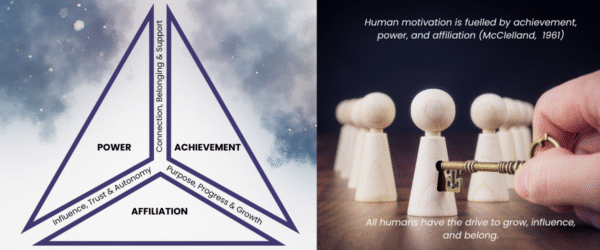
Employee engagement and motivation models including the Gallup Q12 Engagement Model, the Job Characteristics Model, Maslow’s Hierarchy of Needs, Herzberg’s Two-Factor Theory and Self-Determination Theory. These all help leaders focus on boosting satisfaction, productivity and employee retention. But for all of them you need the basics right and there is no point rushing in with a job characteristics model when you haven’t met the basis levels of human needs.
Innovation & Growth Models
Another suite of models which have grown in popularity, initially in the tech sector, are innovation and growth models such as Design Thinking, Lean Startup, the Stage-Gate Innovation Model and Rogers’ Diffusion of Innovations. These all can be used to encourage adaptability, creativity and scalable success. However, many of these models have been used detrimentally in some industries so there are always risks associated with using models and these should be understood.
5 Why’s Model
Interestingly, one model which we didn’t even used to know was a model, but something we use frequently with our clients is the Five Whys.
One example of this was when leaders were frustrated with a company consistently missing deadlines to launch new product campaigns. A summary is below of how the root cause was identified, which is another name for this model.
- Why are product deadlines being missed?
→ Because product assets are not ready on time. - Why are product assets not ready on time?
→ Because the design team receives briefs later than planned. - Why does the design team receive briefs late?
→ Because the campaign plans are often finalised at the last minute. - Why are campaign plans finalised at the last minute?
→ Because the approval process from senior management takes too long. - Why does the approval process take too long?
→ Because there is no clear deadline for management feedback, and approvals often get delayed when executives are travelling or busy with other priorities.
This one is a brilliant example, as it was the leaders themselves causing the delays but this was resolved everyone spend much less time chasing and had more time to deliver.
This is a great tool to help diagnose what is the actual problem which needs to be solved? Are we looking at the symptoms? Or are we looking at the cause? Who has the power or control to provide the solution, or influence the solutions? It certainly wasn’t down to the Product Assistant who spent the majority of their job chasing managers for approval to be able to establish firm deadlines but once the issue was uncovered it was quickly resolved – improving work for everyone.
Next Steps
Join us for our next insight, where we explore a suite of 100 powerful models—many of which management or leadership consultants have never encountered, and that few (unless they’re psychologists or trained executive coaches) know how to apply effectively.