A business can tap into a vast array of models depending on whether its focus is strategy, operations, people, innovation, change or culture. Some of these were highlighted in last week’s insights.
Yet, many management and board consultants have limited, or even no, awareness of the hundreds of models grounded in psychological theories, research and most importantly proven scientific methods.
Psychology is vital for businesses because it helps you understand how people think, feel and behave. It is a science which can help you make better decisions, build stronger teams and create workplaces where everyone can do their best work.
The table below provides a high level overview of some of the models that have been developed:

Forward thinking businesses can tap into over a century of psychological research to improve leadership, teamwork and performance.
Personality Models
One of the main areas which businesses focus on, often to the detriment of other areas, is personality & individual differences.
Personality is the unique combination of traits, behaviours and patterns of thinking and feeling that consistently shape how a person interacts with the world.
Various models, like the Big Five (OCEAN), Cattell’s 16 factors, Saville Wave or Strengthscope can help leaders and organisations, understand more about their employees.
Personality is one element of what makes us human, and every individual is unique so understanding traits can help enhance performance. Utilising models such as Locus of Control can help coach people, and teams, in how to respond effectively to challenges.
Models of Motivation & Needs
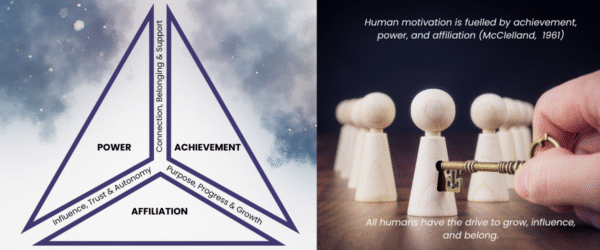
Motivation is the internal drive or external influence that initiates, guides and sustains goal-directed behaviour, or indeed any behaviour. This can be conscious or unconscious. The basics of Maslow’s Hierarchy or Herzberg’s Two-Factor Theory, to Self-Determination Theory can help leaders understand what drive people to perform at their best.
Other factors may influence this performance, such as culture, situation, time or wellbeing but understanding human needs is key to ensuring effort is spent in areas which deliver results. There is no point in spending money on development, when organisations aren’t meeting basic needs – such as paying a fair wage so people can live.
Cognitive & Learning
Cognitive relates to the mental processes involved in acquiring knowledge and understanding, such as thinking, learning, memory and problem-solving.
Theories, such as Kolb’s Learning Cycle or Bloom’s Taxonomy, reveal how we process and apply knowledge which is crucial when understanding how to train and develop employees, or leaders for today and tomorrow. The effectiveness of training courses, online or face to face, and induction programmes is often overestimated and can cause various challenges in organisations when leaders report ‘no change in behaviour’ as a result of training and development.
Learning is the process of acquiring, modifying or reinforcing knowledge, skills, behaviours or attitudes through experience, study or instruction.
Ironically, instruction is one of the least effective methods for helping change behaviours, despite it being the preferred option for many trainers. In fact, behavioural models can provide much more insight into how to embrace new ways of working (wow).
Behavioural Models
How we think, feel, respond physically and then behave, is all inter-linked and cross-linked. Behavioural models like Operant Conditioning or Social Learning Theory explain how habits and workplace behaviours form.
Using these behaviour models, which can be frameworks or theories to explain, predict and guide how individuals or groups act in specific situations can help leaders by identifying factors that influence those actions.
The social impact of culture on behaviour in business is the way shared values, norms and beliefs shape employees’ actions, decisions and interactions, ultimately influencing organisational performance and reputation as a whole.
Humans learn from watching other humans, not just doing what they say.
Modelling Emotions
Emotional intelligence is the ability to recognise, understand and manage your own emotions and those of others to guide thinking, behaviour and relationships effectively.
Social intelligence is the ability to understand and navigate social situations effectively by perceiving, interpreting and responding appropriately to the behaviours, emotions and dynamics of others.
Frameworks such as Goleman’s EI or Plutchik’s Wheel of Emotions can help explain away some of the complexity which equips leaders to manage emotions and relationships effectively.
Group Dynamics
Group dynamics is the study of how people interact, influence and behave within a group. This includes the patterns, roles, and relationships that shape how groups function. These include things such as Tuckman’s Stages and Social Identity Theory.
These theories explain how individuals form, maintain and function within groups based on shared goals, identities, and social structures that exist. Closely connected are group dynamics which examine the patterns of interaction, influence, and relationships within those groups.
Together, both are vital to organisational success because they affect collaboration, communication, decision-making and overall team effectiveness. This impacts performance, innovation and workplace culture and whilst complex, it measurable, and can help leaders ensure teams form, cooperate and succeed. They can also explain why groups sometime fail.
Decision-Making & Judgement Models
Decision-making models are structured frameworks that guide individuals or organisations through a systematic process to evaluate options and choose the most effective course(s) of action.
Often human thinking can create biases, assumptions and lead to ineffective decision making so models like Prospect Theory or Dual-Process Theory can help explain why people make the choices they do under uncertainty.
Tools such as RACI or RAPID, many of which are trade-marked, can help empower effective decision making by helping take out some of the emotion and provide more objective clarity.
However, effective team performance is often an outcome of using a suite of theories and psychological models, unique to the who, what, when, where, when and how success will look.
Health & Well-being
In many ways, the health continuum is the main model for this category but in reality individuals are predisposed to health, or poor health, based on physical, genetic and psychological factors.
Frameworks such as PERMA, Job demands-resources and burnout models can help provide insights but often it is multifaceted what causes stress and unsustainable performance in organisations.
Organisational leaders who promote health and wellbeing at work, need to strive for a holistic state in which employees are physically, mentally and socially supported to thrive, perform effectively and sustain long-term productivity.
Often surface level efforts can have detrimental effects, or mask deeper challenges which is where organisational psychology becomes paramount.
Organisational & Work Behaviour
An organisation is an entity formed by people working together in a structured way to achieve shared goals or purposes through coordinated activities and resources.
In many ways, organisations are a living breathing entity.
In terms of the thoughts, feelings and emotions, people can connect with organisations or brands. Organisations are more than just a physical object, in that they exist because people agree on the structure, purpose and rules which make that organisation.
There may be tangible elements, like buildings or equipment, products or services, but organisations are all unique and successful organisations harness this for commercial gain.
Schien’s culture model, or leader-member exchange theories, help explain how it feels to be part of an organisational entity. There is no right or wrong as such, but alignment, consistency and direction anchored to a purpose is fundamental.
Unlike therapeutic psychologists, organisational psychologists are not registered medical practitioners with the HCPC. However, it is important that they hold an MSc in Occupational Psychology or a Psychology degree, along with accreditation from the British Psychological Society and ideally the Association of Business Psychology.
Clinical & Therapeutic Interventions
Whilst many workplaces offer counselling via employee assistance programmes (EAPs), therapeutic approaches are generally reserved for outside workplaces.
Yet, increasingly, managers are being called upon to help deal with mental health challenges, or other more serious blockers to performance.
Often therapeutic interventions come when employees are experiencing mental health challenges, such as stress, anxiety, depression, trauma or burnout, which have become serious, and visible, affecting their wellbeing, performance, or workplace relationships.
Often early intervention, confidential support or structured treatment can help them recover and function effectively, and a proactive approach delivers significant benefits and ROI.
Cognitive behavioural therapy (CBT) is a common intervention which if understood and utilised when people are well can be much more beneficial as a preventative tool. CBT coaching can also help individuals overcome blocks and thrive.
Psychology offers businesses a vast, evidence-based toolkit to understand and influence how people think, feel and behave.
By tapping into proven models, from personality and motivation to decision-making, group dynamics and wellbeing, leaders can make better decisions, build stronger teams and create workplaces where employees thrive.
Forward-thinking organisations that integrate these insights don’t just improve performance, they foster a culture where people can do their best work, every day – sustainably.
Contact sam@thinkorganisation.com to get our Top 100 Models or book a free 30-minutes insights session with us.