When resources are tight, motivation can feel like an impossible luxury. You can’t tell someone to be more motivated. In fact, it is difficult to tell yourself to feel more motivated when you are not. Yet some of the most inspired teams Think Organisation have helped create weren’t driven by bonuses or financial incentives they were powered by purpose, trust, and recognition. All of which was inspired by leaders who knew how to lead.
It is vital to acknowledge a truth often overlooked in these conversations: motivation cannot be built on an unfair foundation. No amount of purpose or positivity can compensate for people not being paid enough to live well. No amount of inspiring leadership can boost motivation when people know they are not being treated fairly. But what is fairly?
As a minimum, paying the Real Living Wage and aligning with frameworks like the Good Employment Charter, isn’t just ethical, it’s essential for long-term engagement, retention, and trust.
All organisations need to get the basics right, so as we wait for a looming budget, struggle with ever increasing NI costs and find payroll budgets squeezed, the first step for any organisation, or leader, who mentions the importance of culture in their organisation is to be transparent about your commitment to fairness and your plan to meet those standards.
Motivation thrives in cultures where integrity takes precedence over superficial incentives.
But what do leaders really need to understand about motivation when it comes to balancing budgets?
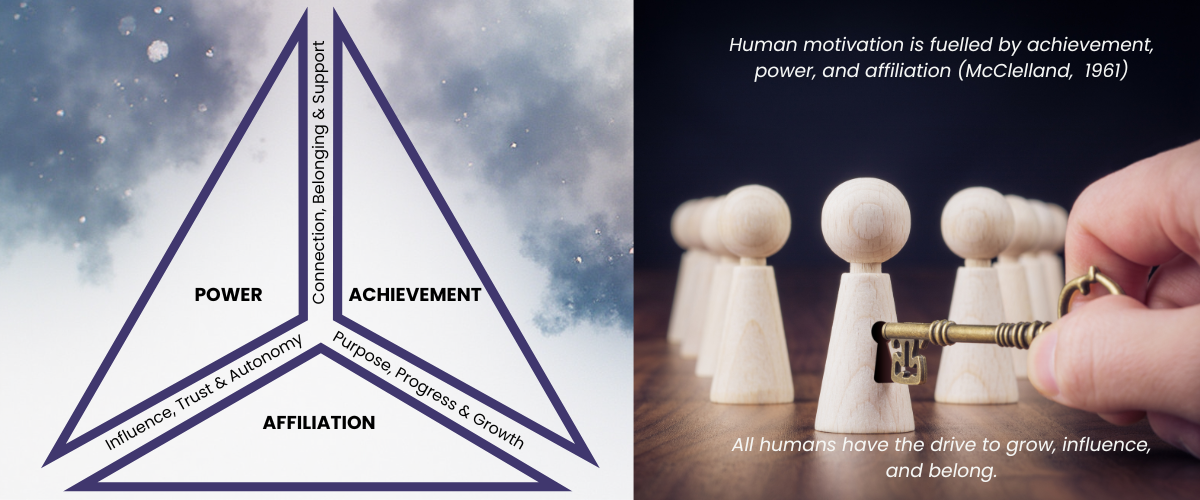
Maslow’s Hierarchy of Needs has gained popularity in recent years, and Psychologist David McClelland’s model proposed that three core drivers shape human motivation at work, which is much more practical for many leaders to utilise in terms of delivering an impact on performance.
The first need is achievement, the second is power and the third is affiliation which are outlined below.
1️⃣ Achievement – the desire to excel, improve, and see results.
2️⃣ Power – the drive to influence, make an impact, and feel trusted.
3️⃣ Affiliation – the need for connection, belonging, and positive relationships.
Leaders can draw on these three drivers to energise their teams in meaningful ways, tapping into intrinsic human needs.
Remember some people are driven equally by all three, whereas others may have higher preferences for one or two of the different needs. Leaders can help utilise these three drivers, or needs by taking the following steps.
1️⃣ Reconnect People to Purpose (Achievement)
When people feel disconnected, money rarely fixes it. Meaning does. A small bonus may improve performance momentarily, if at all, but creating connection is what taps in to our innate needs for achievement. This is that warm feeling you get when you deliver something exceptional, or complete something which matters for someone.
Leaders need to remind teams why their work matters. Not just to the organisation, and the individuals, but to customers and communities.
Allowing these stakeholders to show how much they value what the employee is delivering for them is even more powerful. Allow employees to listen to, and hear, real stories of impact, not just performance metrics.
People with high achievement motivation as a driver thrive when they see tangible progress and purpose in their work.
2️⃣ Create Psychological Safety (Affiliation)
All humans need to feel like they belong. Employees with strong affiliation needs will be driven by being connected, being part of a group and having strong relationships with other employees.
Those with lower affiliation preferences, which never means no affiliation preferences, may be less focused on connections.
However, as we have seen with DEI initiatives – everyone needs to feel included and that they belong.
A team where people don’t feel they belong often masks fear or frustration. Employees are disengaged. And to overcome this leaders need to create safe spaces for honest conversations.
Asking supportive questions such as “What is currently hindering you, or getting in the way of you, doing your best work?”, or “What would make the biggest positive difference to how you feel at work today?” can both help identify what is needed.
And then leaders must act. When people feel listened to and included, their need for affiliation is met, but they also need help resolving challenges and to see improvements which restores trust and belonging.
3️⃣ Give Autonomy and Responsibility (Power)
Leaders who can’t let go will undermine their teams and take away any power. This can be difficult as some individuals have a higher need, or driver, for power. If these people become the leaders it is vital to manage this driving need, especially when others in the team may also have this as a preferred need.
Micromanagement kills motivation faster than any pay freeze or lack of bonus.
People need to feel trusted and know what they can control. Giving people more control over how they deliver outcomes is the first step.
Empower people to make decisions and lead projects. This satisfies the need for power. The ability to see how they have the power to decide their own destiny.
Leaders need to set employees up for success. Power is a need, but it is not about dominance or control. This needs is a positive kind that comes from influence and ownership as if this turns negative then the other needs, achievement and affiliation quickly suffer and everyone needs all three to some degree to feel motivated.
4️⃣ Recognise, Often and Authentically (Affiliation + Achievement)
People like to feel noticed. Many leaders we have worked with fail to recognise the hard work of their teams.
Changing goal posts, or moving what is required when someone has already invested time. effort and resources quickly creates frustration and often leads to people stepping back and becoming disengaged.
It is important to remember that recognition doesn’t have to be financial. But it does need to mean something.
Say “thank you” publicly can be extremely motivativational for some, and cringeworthy for others. Celebrating milestones not completions (as progress is vital) and little and often has a much bigger impact on performance.
Acknowledge both outcomes and effort. When recognition connects to team values and shared purpose, it fuels both achievement and affiliation needs.
Individuals have other drivers, e.g. to be affiliated with their family so recognition which supports the whole of their life can be a double driver so think creatively.
5️⃣ Develop Without a Budget (Achievement)
Growth opportunities don’t always mean expensive courses. Especially in todays world where growth, development and learning from others is about time more than financial investments.
Leaders can offer the following:
- Offer stretch assignments or cross-team projects aligned to what the individuals are interested in
- Promote peer mentoring or job shadowing, bringing people in on opportunities
- “Lunch and Learn” sessions led by team members can be invaluable to both the deliverer and the attendees
Those with a higher need for achievement will thrive when challenged and supported to grow, and everyone needs this to some extent.
Monotony or complacency occurs when people are not developed and stretched in their roles.
A Culture of Motivation
People become disengaged when they feel kept in the dark. Whereas camaraderie fuels team dynamics and builds individual and group resilience.
Leaders need to encourage connection beyond the task list. This is how cultures of motivation are truly created. So that when times get tough, people come together, not apart.
Many companies promote volunteering, use this as time to spend together as a team. Shared coffees or “win of the week” check-ins help people feel part of something bigger than themselves.
Importantly, don’t just focus on the positives. Humans like to be part of the solutions. This brings all three needs and drivers together. Share openly current challenges and progress, ask for help and support in ensuring your organisation is a good employer.
Leadership presence, shown by listening, being empathetic and demonstrating fairness, signals integrity and builds the kind of trust-based power that motivates others to follow. Which becomes a self-sustaining culture of motivation.
Motivation is psychological, emotional, and moral. It is not just financial.
When you can’t offer more money, offer more meaning, autonomy, and belonging.
When you can’t expand budgets, expand trust.
And when you can’t promise change overnight, promise fairness and transparency and deliver what you say you will.
Progress is crucial. That’s what fuels motivation.